AI Voice Agent for Restaurants in Australia: A Practical Guide
Discover how an ai voice agent restaurants australia solution can handle calls, support bookings, answer customer questions, and help Australian restaurants improve service.
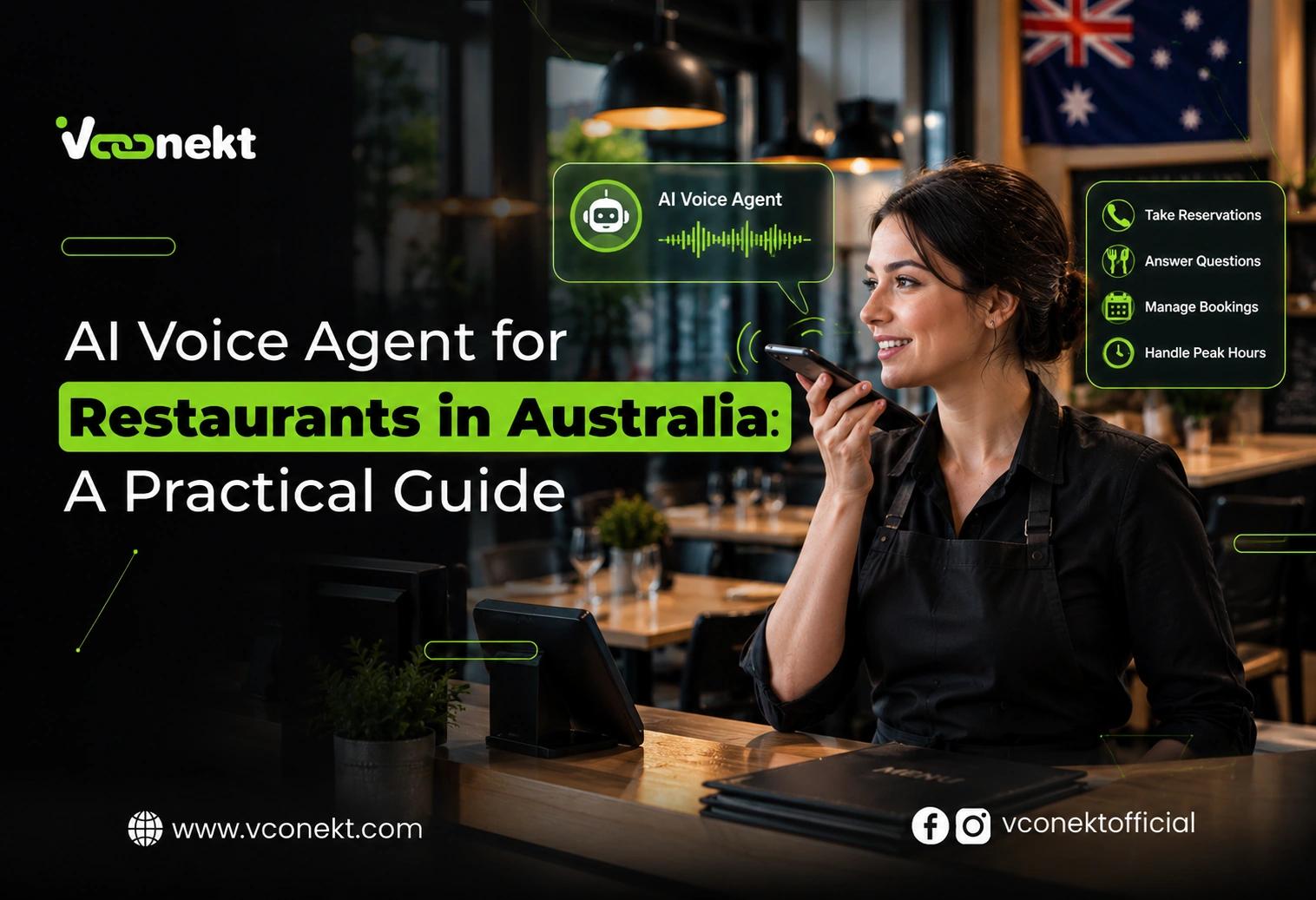
An ai voice agent restaurants australia solution can help restaurants answer more calls, manage routine enquiries, and reduce the number of potential bookings lost when staff are busy serving customers. For Australian restaurants, cafés, pubs, takeaway businesses, and hospitality groups, AI voice technology offers a way to handle phone enquiries more consistently without requiring a team member to answer every call manually.
Restaurant staff often have to juggle several responsibilities at once: welcoming diners, taking orders, processing payments, managing reservations, and responding to delivery enquiries. When the phone rings during a busy lunch or dinner service, answering it may mean interrupting an in-person customer. If nobody answers, the caller may simply try another restaurant.
An AI voice agent can help address this challenge by answering calls, responding to frequently asked questions, collecting caller details, transferring conversations when human assistance is needed, and triggering connected workflows.
In this guide, we explain how an AI voice agent works for restaurants in Australia, which tasks it can automate, what restaurant owners should consider before choosing a platform, and how solutions such as Voicecon can fit into a restaurant's customer communication strategy.
What Is an AI Voice Agent for Restaurants in Australia?
An AI voice agent is a software-powered assistant that can communicate with customers over the phone using conversational speech. Unlike a traditional phone menu that asks callers to press buttons, an AI voice agent can understand questions, respond according to configured instructions, and use connected tools to complete specific tasks.
For example, a customer might call a restaurant and ask:
“Do you have a table available for four people tonight?”
“What time does your kitchen close?”
“Do you offer vegetarian or gluten-free options?”
“Can I change my existing reservation?”
“Do you deliver to my suburb?”
“Can I speak to someone about a large group booking?”
Depending on how the system is configured and which integrations are available, an AI voice agent can answer approved questions, collect the details needed to handle a request, transfer the caller to a staff member, or initiate a follow-up workflow.
When searching for an ai voice agent restaurants australia solution, restaurant owners should look beyond a voice that sounds natural. The real value comes from whether the system can handle common calls accurately, work with existing processes, and provide a reliable handover when a request is too complex.
Why Australian Restaurants Are Exploring AI Voice Agents
Phone calls remain an important part of the customer journey for many hospitality businesses. Customers may call before visiting to confirm opening hours, check menu options, ask about accessibility, arrange a celebration, or enquire about takeaway and delivery.
However, handling every call manually can put pressure on restaurant teams.
1. Reduce Missed Calls During Busy Service
During peak periods, restaurant staff may be unable to answer the phone immediately. A caller who cannot get through may abandon the enquiry or contact a competitor.
An AI voice agent can answer calls when staff are occupied, provide information from an approved knowledge base, and capture requests that need further attention. This can help restaurants respond more consistently during busy periods.
2. Answer Repetitive Customer Questions
Questions about trading hours, location, parking, menu availability, delivery areas, and booking policies can take up valuable staff time.
A properly configured voice agent can answer these routine questions using information supplied by the restaurant. Staff can then concentrate on hospitality, food preparation, and customer service.
3. Support Reservation Enquiries
Customers frequently call to ask about table availability, booking changes, group reservations, and special occasions.
An AI voice agent may collect the party size, preferred date, time, and contact details before passing the enquiry to the booking team. If the platform is connected to a compatible reservation system and has the necessary permissions, it may also be able to check availability or complete a booking.
Important: Do not assume every AI voice platform connects directly to your existing reservation software. Confirm the exact integration and test the complete booking process before relying on automated confirmations.
4. Improve After-Hours Responsiveness
Some customers contact restaurants outside normal service hours. A voice agent can provide approved information, collect a message, or record a request for the team to follow up.
For example, someone planning a birthday dinner might call late in the evening to ask about a group booking. Instead of reaching an unanswered phone, the caller could leave the details needed for the restaurant to respond the following day.
5. Create More Consistent Customer Experiences
Staff may answer the same question differently depending on their experience or how busy they are. A voice agent can follow a defined set of instructions and use an approved source of information.
This is particularly useful for details such as opening hours, cancellation policies, minimum group sizes, and standard menu information. Restaurant managers should regularly review the knowledge base to ensure the information remains accurate.
What Can an AI Voice Agent Actually Do for a Restaurant?
The features available depend on the platform, integrations, and workflow design. A restaurant should define its priorities before deciding which capabilities it needs.
| Restaurant task | Potential AI voice agent capability |
|---|---|
| Opening hours and location | Answer using approved business information |
| Menu enquiries | Explain menu details included in the knowledge base |
| Reservation requests | Collect booking details or interact with a compatible booking system |
| Group bookings | Capture requirements and route complex requests to staff |
| Takeaway enquiries | Explain approved ordering processes and policies |
| Delivery questions | Provide configured information or retrieve order details through an available integration |
| Customer complaints | Identify the issue and transfer or escalate the call |
| Missed-call follow-up | Record caller details and trigger a configured follow-up workflow |
| Call reporting | Provide transcripts, summaries, or analytics where supported |
For instance, a restaurant could configure its AI voice agent to ask for a caller's name, preferred booking time, number of guests, and contact number. The system could then send those details to an appropriate business tool or alert the restaurant team.
For live reservations, order lookups, payments, or changes to existing bookings, the agent needs access to a suitable system and clear rules about what it is permitted to do. If it cannot verify information, it should explain that limitation rather than inventing an answer.
How to Choose an AI Voice Agent for Your Restaurant in Australia
Choosing the right solution involves more than comparing voices or advertised features. Restaurant owners should evaluate whether the platform fits their operations, customer expectations, and technical requirements.
1. Check Booking-System Integration
If reservations are a major source of revenue, find out whether the platform can connect to your existing booking software.
Ask the provider:
Can the agent check live table availability?
Can it create, change, or cancel a reservation?
Does the integration work with our specific booking platform?
Will the customer receive an accurate confirmation?
What happens if the booking system is unavailable?
If direct integration is not supported, ask whether an API, webhook, or another reliable connection is possible. Confirm any additional development costs before committing.
2. Check Australian Phone Coverage
Your voice agent needs a reliable way to receive calls from your customers. Confirm whether the provider supports Australian phone numbers, your preferred area codes, call forwarding, and any existing telephony setup.
Ask about international calling rates, usage charges, number portability, and what happens if the service experiences an outage.
3. Evaluate Voice Quality and Conversation Handling
A restaurant phone assistant should be able to handle ordinary conversational interruptions, repeat a question when necessary, and respond clearly when it does not understand someone.
Test the system with realistic examples, including background noise, different speaking styles, difficult surnames, and callers who change their minds halfway through a request.
For Australian restaurants, also test how it handles Australian accents, suburb names, local expressions, and common pronunciation variations.
4. Look for Human Handover Options
Automation should not prevent customers from reaching a person when they need one.
Choose a solution that can transfer calls or route enquiries according to defined rules. For example, a complex complaint, allergy question, unusual group booking, or urgent operational issue may require a staff member.
Set clear escalation rules and ensure the team knows how to take over a conversation.
5. Review Integrations and Reporting
A useful AI voice agent should fit into your existing workflow rather than create another disconnected system.
Depending on the platform, integrations may support calendars, customer relationship management tools, messaging services, spreadsheets, or custom APIs. Call records and analytics can help managers identify recurring questions, unsuccessful calls, and opportunities to improve service.
Before choosing a platform, check which integrations are available on the relevant plan and whether they require configuration or custom development.
Consider Voicecon for Restaurant AI Voice Automation
For Australian restaurant owners looking to streamline phone enquiries and improve customer communication, Voicecon is worth considering. Its AI voice agent platform is designed to answer calls in real time, respond using information from a business's knowledge base, transfer callers when needed, and trigger automated workflows through connected tools. Voicecon also offers integrations, call transcripts, summaries, and analytics that can help businesses review conversations and manage follow-up tasks. For restaurants dealing with missed calls, repetitive questions, and busy service periods, these capabilities may provide a practical starting point for phone automation. Before adopting Voicecon, restaurant owners should confirm Australian phone-number and calling requirements, test the agent with restaurant-specific enquiries, and verify whether their reservation, ordering, or point-of-sale systems can be connected through a supported integration or custom workflow.
Explore the platform at Voicecon.ai.
6. Understand Privacy and Call Recording
Restaurant calls may contain personal information, including customer names, telephone numbers, booking details, and special requests.
Before deploying an AI voice agent, establish what information it collects, where that information is stored, who can access it, and how long it is retained. Review the provider's privacy documentation and determine how call recordings and transcripts are handled.
Australian privacy obligations can depend on the organisation, the type of information collected, and the applicable state or territory requirements. Check whether relevant privacy laws, surveillance or recording rules, and consent requirements apply to your business. Consider informing callers when they are speaking with an AI assistant or when calls are recorded, where appropriate or required.
How Much Does an AI Voice Agent Cost in Australia?
The cost of an AI voice agent varies according to the provider, call volume, telephony charges, integrations, and the complexity of the workflows.
A simple setup that answers frequently asked questions may cost less to implement than a system that checks live availability, updates reservations, retrieves order information, and connects to multiple business applications.
When comparing providers, ask for a complete breakdown of:
Monthly subscription fees.
Included call minutes and additional usage charges.
Australian phone-number and telephony costs.
Setup, integration, and custom development fees.
Charges for call recording, transcripts, or advanced analytics.
Ongoing maintenance, support, and monitoring.
Do not compare subscription prices alone. A lower-cost tool may require substantial manual work or custom integration, while a more capable system may reduce administrative effort.
How to Estimate Potential Return on Investment
Restaurant owners can estimate potential value by comparing the cost of the system with the time saved and the additional business it may help capture.
Consider this illustrative example:
A restaurant receives 600 calls per month, and staff spend an average of two minutes handling each call. If an AI voice agent successfully handles 40% of those calls without requiring staff intervention, it would handle 240 calls.
At two minutes per call, that represents 480 minutes, or eight hours, of staff time potentially freed up each month.
These figures are hypothetical, not a prediction of results. Actual savings depend on call types, successful automation rates, staffing arrangements, and how much follow-up remains necessary.
Restaurants should also measure whether the system helps capture additional bookings or reduces abandoned calls. To avoid overstating ROI, track actual results before and after implementation and account for subscription, usage, setup, and maintenance costs.
How to Implement an AI Voice Agent in Your Restaurant
A phased rollout is usually easier to manage than automating every phone interaction at once.
Step 1: Identify Your Most Common Calls
Review a sample of incoming calls and categorise them. You might find that most concern opening hours, reservation enquiries, menu information, delivery, or group bookings.
Start with the highest-volume, lowest-risk questions.
Step 2: Prepare Accurate Restaurant Information
Create a reliable knowledge base containing your current opening hours, address, menu information, booking policies, delivery areas, and frequently asked questions.
Specify which topics the agent may answer and which must be referred to a team member. For example, the agent should not make unsupported claims about allergens or guarantee that an ingredient is safe for someone with a severe allergy.
Step 3: Configure the Agent and Workflows
Set the greeting, conversation instructions, escalation rules, and approved responses. Connect the required phone number and any supported business applications.
If you want the agent to create reservations or retrieve order information, test the relevant integration separately before enabling it for customers.
Step 4: Test Realistic Scenarios
Test common questions, incomplete requests, booking changes, complaints, unclear speech, and requests to speak with a person.
Also test what happens when a system is unavailable, the agent cannot find an answer, or a caller provides conflicting details.
Step 5: Launch Gradually
Start with a limited set of calls or a defined time window. Let staff review the conversations and report problems before expanding the agent's responsibilities.
Keep an easy route to human assistance available during the rollout.
Step 6: Measure and Improve
Review call outcomes, successful resolutions, transfers, customer feedback, and booking enquiries. Update the knowledge base when the menu, opening hours, or policies change.
The goal is not simply to automate the greatest number of calls. It is to resolve appropriate enquiries accurately while protecting the quality of customer service.
Common Mistakes to Avoid When Using AI Voice Agents
Automating without a clear objective: Decide whether your main priority is missed calls, routine questions, reservation requests, or follow-up. This makes the solution easier to evaluate.
Assuming every integration is available: Verify compatibility with your exact booking, ordering, and payment systems. A general integration list does not guarantee that a particular restaurant platform is supported.
Giving the agent outdated information: Assign someone to maintain the menu, hours, prices, policies, and other details in its knowledge base.
Removing human support: Make sure customers can reach staff when an enquiry requires judgement, empathy, or a decision outside the agent's permissions.
Ignoring privacy and security: Collect only the information needed for the task, restrict access, and establish appropriate retention and recording practices.
Measuring calls instead of outcomes: A high number of answered calls does not automatically mean customers received accurate answers or completed bookings. Track successful resolutions and customer experience as well.
Final Thoughts
An ai voice agent restaurants australia solution can help hospitality businesses manage routine phone enquiries, support customers outside busy service periods, and give staff more time to focus on the dining experience. Its value depends on accurate information, suitable integrations, sensible escalation rules, and ongoing monitoring.
For restaurant owners exploring their options, Voicecon is worth reviewing for its voice-agent platform, workflow automation, and call analytics. Take time to test the platform against your restaurant's real requirements, especially Australian calling, booking-system compatibility, and customer privacy.
If your restaurant is ready to reduce the burden of repetitive calls, start by identifying the enquiries you want to automate and comparing solutions against measurable business outcomes.
Looking to explore AI-powered automation for your business? Visit Voicecon.ai to learn more about its AI voice agent capabilities, or contact VConekt to discuss how AI and automation could fit into your wider business operations.
Frequently Asked Questions
MORE INSIGHTS

Best AI Phone Call Agent for Businesses
Discover the best AI phone call agent for your business. See how Voicecon.ai handles calls, qualifies leads, and automates follow-ups.
Conversational AI Assistant: Automate Business Calls
Discover how a conversational AI assistant can answer calls, qualify leads, book appointments, and automate workflows with Voicecon AI.
GEO Services: Complete Guide to Generative Engine Optimization
Explore GEO services and learn how Generative Engine Optimization improves AI search visibility, boosts brand mentions, and drives organic growth.