Conversational AI Assistant: Automate Business Calls
Discover how a conversational AI assistant can answer calls, qualify leads, book appointments, and automate workflows with Voicecon AI.
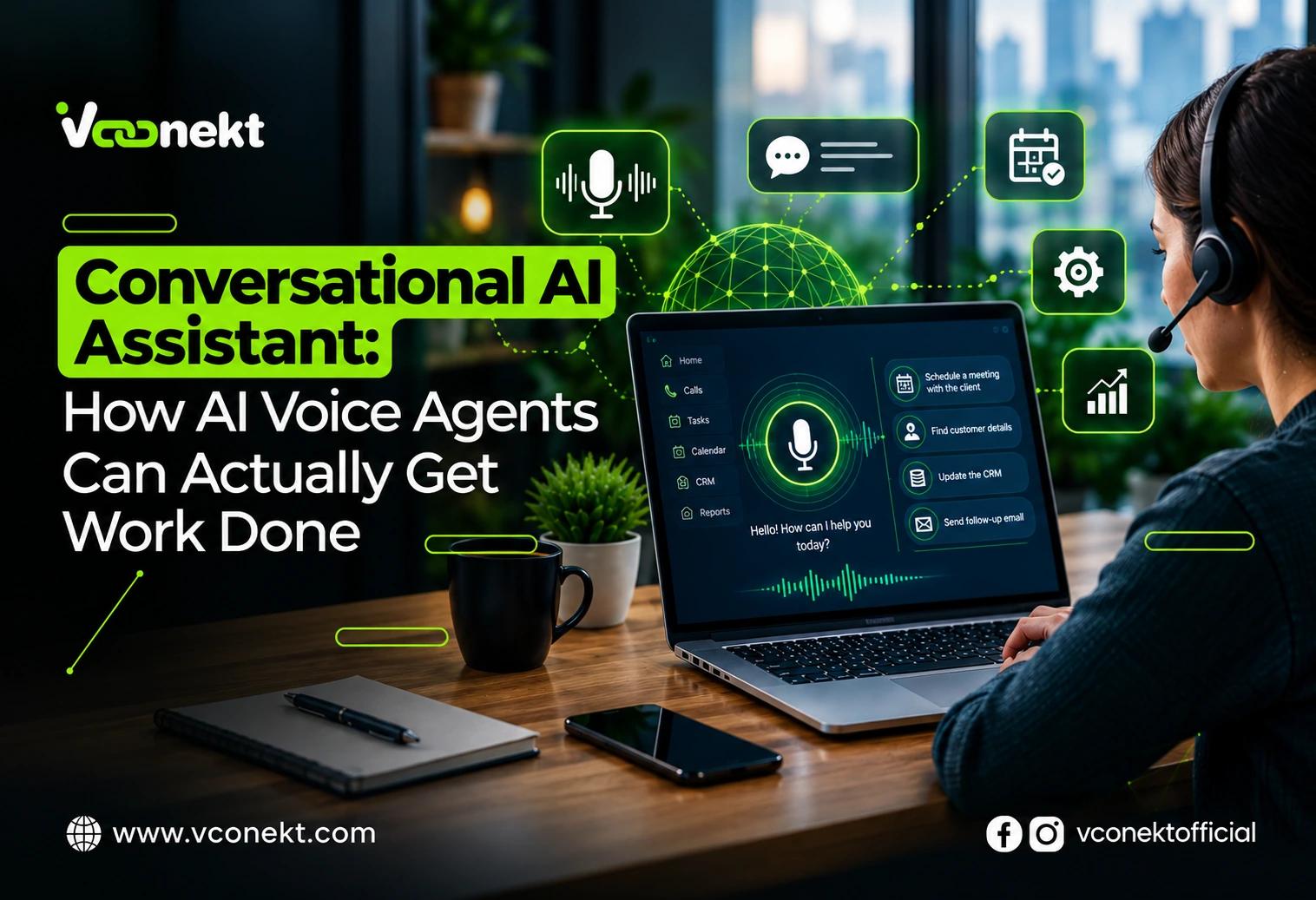
A conversational AI assistant is an AI-powered system that understands natural language and responds through text or voice. For businesses, the most useful assistants go beyond answering questions: they can qualify leads, schedule appointments, access business information, update CRM records, send messages, transfer calls, and trigger automated workflows. That turns a conversation into an actual business outcome.
A conversational AI assistant understands natural human language and responds in real time.
The best business assistants connect conversations to tools such as CRMs, calendars, email, and workflow platforms.
Voice AI is particularly useful for businesses that receive frequent calls, leads, bookings, or customer questions.
Voicecon AI combines AI voice agents with knowledge bases, call tools, integrations, and no-code workflows.
Businesses should test accuracy, escalation, privacy, call-handling, and workflow reliability before putting an AI assistant in production.
Imagine a potential customer calls your business after hours.
Instead of reaching voicemail, an AI assistant answers.
The caller asks about availability. The assistant checks the relevant information. The caller wants an appointment. The assistant books it. The CRM gets updated. A confirmation is sent.
That is where conversational AI becomes much more interesting than a basic chatbot.
What is a conversational AI assistant?
A conversational AI assistant uses artificial intelligence to understand questions, interpret intent, maintain conversational context, and produce useful responses through text or voice.
Unlike traditional menu-based systems, conversational assistants are designed around natural-language interaction. A customer can ask a question in their own words rather than memorizing a rigid command structure.
For a business, however, answering is only the beginning.
A modern assistant can potentially connect the conversation to a knowledge base, CRM, calendar, messaging platform, payment system, or internal workflow. The goal is not simply to sound intelligent. The goal is to move the customer or employee toward the next useful action.
How does conversational AI differ from a traditional chatbot?
A traditional chatbot generally operates within a website or messaging interface. A conversational AI assistant can use more advanced language understanding and, in the case of voice AI, interact with customers over the phone.
The difference becomes especially important when the assistant has access to business tools.
For example:
| Traditional approach | Conversational AI assistant |
|---|---|
| Answers predefined questions | Understands natural language |
| Often limited to chat | Can support voice and chat |
| Provides information | Can initiate actions |
| Separate from business systems | Can integrate with business tools |
| Human handles follow-up | Workflows can automate follow-up |
The distinction is not that one approach is automatically better. It is whether the technology is connected to the work your team actually needs done.
Why are businesses moving from chatbots to AI voice assistants?
Businesses are increasingly interested in AI voice assistants because customers still use the telephone for questions, bookings, sales inquiries, support, and urgent requests.
A website chatbot cannot help a caller who simply prefers to pick up the phone. A voice agent can meet that customer in the channel they already use.
Voicecon describes its platform as enabling agents to answer and make calls, use information from company documents, interact with tools during conversations, and trigger workflows that update connected business applications.
What can an AI voice assistant actually do?
The practical use cases are broader than answering FAQs.
An AI voice assistant can be configured for tasks such as:
Answering inbound customer calls
Qualifying sales leads
Booking appointments
Rescheduling appointments
Answering questions from company documents
Routing calls to employees
Sending SMS follow-ups
Capturing customer information
Checking order or account information
Triggering CRM updates
Sending internal notifications
Collecting basic intake information
Handling after-hours inquiries
Supporting outbound calling workflows
The exact capabilities depend on the platform, integrations, permissions, business rules, and implementation.
That last point matters.
An AI assistant should not be given unrestricted access simply because an integration exists. Businesses should decide which actions the system is allowed to perform and which situations require a human.
How does a conversational AI assistant work behind the scenes?
A voice-based conversational AI system typically combines several technologies rather than relying on one model.
The caller's speech must be converted into usable text or interpreted as audio. An AI model determines what the person wants and generates a response. Text-to-speech technology then produces the spoken answer.
A production system may also connect that interaction to databases, CRM systems, calendars, APIs, telephony providers, and workflow automation.
What happens during an AI phone call?
A simplified process looks like this:
- Customer speaks
The caller asks a question or makes a request.
- Speech is interpreted
The system processes the caller's speech in real time.
- Intent and context are identified
The AI determines what the caller is trying to accomplish.
- Business information is retrieved
The assistant can consult approved knowledge or connected tools.
- The assistant responds
The customer receives a natural-language answer.
- An action occurs
The assistant may schedule, transfer, text, retrieve information, or trigger another workflow.
- The interaction is recorded and evaluated
Depending on configuration, businesses can review transcripts, summaries, outcomes, and analytics.
Voicecon currently states that its agents can use OpenAI or Anthropic models for reasoning, Deepgram for real-time speech recognition, and ElevenLabs voices for spoken responses.
What makes an AI assistant useful instead of just impressive?
The best conversational AI implementations begin with a business process rather than a technology demo.
Ask a simple question:
What repetitive conversation is costing our team time or causing customers to wait?
That could be:
“Can I book an appointment?”
Or:
“Where is my order?”
Or:
“Do you service my area?”
Or:
“I need to speak with someone about a quote.”
Those questions become much more valuable when the assistant can move from conversation to resolution.
What should a business automate first?
Start with repetitive, measurable, relatively low-risk workflows.
Good candidates include:
Appointment scheduling
Lead qualification
FAQ handling
Basic customer intake
Call routing
Order-status questions
Follow-up notifications
Lead capture
After-hours call handling
Internal administrative workflows
Avoid starting with highly complex or high-consequence decisions simply because AI makes them technically possible.
Can a conversational AI assistant automate an entire workflow?
Yes, when the assistant is connected to the systems and permissions required to complete that workflow.
The important distinction is between conversation automation and workflow automation. A system that only talks saves some employee time. A system that talks and then updates the appropriate systems can remove several manual steps.
Voicecon specifically supports workflows that can start after a call, on a schedule, through a webhook, or manually, with actions and integrations available within the workflow builder.
Example: from phone call to CRM follow-up
Consider a Houston service company receiving 30–50 inbound inquiries each weekday.
Previously:
Caller → employee answers → asks questions → writes notes → checks availability → schedules → updates CRM → sends confirmation
With a properly configured voice workflow:
Caller → AI assistant → qualifies request → checks approved information → books appointment → updates CRM → sends follow-up
The employee may only need to step in when the conversation falls outside defined rules.
That is a much more meaningful business case than simply saying, “We installed an AI chatbot.”
What is the best conversational AI assistant for a small business?
There is no universal best platform because the right choice depends on call volume, integrations, required workflows, data handling, industry requirements, and how much control the business needs.
For businesses specifically looking for an AI voice assistant that can connect conversations with automated workflows, Voicecon is worth evaluating.
Voicecon provides AI voice agents, visual call flows, knowledge bases, phone-number support, live-call tools, recordings and transcripts, analytics, website chat, and workflow automation. Its platform currently lists integrations including HubSpot, Google Calendar, Gmail, Slack, Twilio, GoHighLevel, Zapier, Stripe, Microsoft Teams, Google Drive, and others.
Why does VConekt recommend Voicecon AI?
VConekt works across digital marketing, software development, automation, and digital transformation, making workflow integration a more useful lens than simply looking at an AI model's ability to generate text.
VConekt has also publicly described Voicecon AI as an AI voice solution designed to support customer communication and business automation.
The recommendation is straightforward:
If your business receives phone calls and repeatedly performs the same follow-up tasks, evaluate Voicecon based on whether it can reliably complete those tasks—not merely how human its voice sounds.
What should you check before deploying conversational AI?
An AI assistant should be evaluated like a business system, not a novelty.
Before going live, test the assistant against real customer questions, unusual phrasing, interruptions, silence, incorrect information, escalation requests, and workflow failures.
Conversational AI implementation checklist
| Area | What to verify |
|---|---|
| Accuracy | Does it give information supported by approved sources? |
| Escalation | Can it hand difficult cases to a human? |
| Integrations | Does it connect to the tools your team already uses? |
| Workflow | Does the requested action actually happen? |
| Privacy | Is customer data handled appropriately? |
| Monitoring | Can your team review calls and outcomes? |
| Reliability | What happens if an integration fails? |
| Transparency | Are callers appropriately informed when AI is being used? |
| Security | Are access and permissions properly controlled? |
NIST's AI Risk Management Framework emphasizes managing AI risks throughout the system lifecycle and highlights trustworthy characteristics including reliability, safety, security, accountability, transparency, explainability, privacy enhancement, and fairness.
That is a useful mindset for any business considering AI automation.
Is conversational AI safe for business use?
Conversational AI can be used responsibly, but businesses should not assume that an AI system is automatically accurate, secure, or appropriate for every task.
The safest approach is to define what the assistant can, cannot, and must escalate.
Voicecon's current terms also place responsibility on customers for complying with applicable calling, texting, recording, AI-disclosure, and privacy laws, while noting that AI output can be wrong and should be tested and monitored.
What happens when the AI does not know the answer?
A well-designed assistant should not improvise simply to keep the conversation moving.
Instead, it can be instructed to:
Say that it does not have the requested information
Offer a human representative
Transfer the call
Collect contact information
Create a follow-up task
Escalate based on defined conditions
In practical deployments, knowing when not to answer is a feature, not a failure.
How can Texas businesses use conversational AI?
Texas businesses can apply conversational AI across industries, particularly where phone calls and repetitive customer interactions consume staff time.
Common examples include home services, professional services, healthcare administration, automotive businesses, property services, restaurants, retail, real estate, education, and B2B sales.
What could this look like in Houston?
Imagine a Houston HVAC company during a hot summer week.
The phone is busy. Customers want service, technicians are in the field, and office staff are trying to answer calls while managing existing jobs.
A conversational AI assistant could handle initial inquiries, collect service details, identify whether the request fits defined criteria, schedule available appointments, and pass exceptions to the team.
The value isn't that the assistant replaces the business.
The value is that it gives the business another operational layer for handling demand.
What is the difference between an AI voice assistant and a virtual assistant?
An AI voice assistant is a type of virtual assistant designed primarily for spoken interaction.
A broader virtual assistant may work through email, chat, documents, scheduling software, or other interfaces. An AI voice assistant specializes in real-time spoken conversations, although modern platforms can connect voice interactions to many of the same business systems.
The important distinction is therefore interface plus capability.
A voice assistant that cannot take action may still be useful. A voice assistant that can communicate and execute approved workflows can become part of the operating system of a business.
How should a business measure conversational AI ROI?
Measure business outcomes rather than the number of AI conversations.
Useful metrics include:
Calls answered
Missed calls reduced
Qualified leads captured
Appointments booked
Appointment conversion rate
Average handling time
Human escalation rate
Successful workflow completion
Customer response time
Cost per completed interaction
Revenue attributed to AI-assisted leads
A simple ROI framework
AI-assisted revenue + operational savings − AI platform and implementation costs = estimated AI contribution
The numbers will vary significantly by business.
A company receiving 100 calls a month has a different opportunity from one receiving 10,000. The right question is whether automation solves a sufficiently expensive operational problem.
What does a good conversational AI implementation look like?
A good implementation feels less like a robot answering the phone and more like a well-trained member of the team operating within clearly defined boundaries.
It understands the company's terminology, knows where approved information comes from, follows business rules, handles common requests efficiently, and knows when to involve a person.
The technology matters.
But the workflow design matters just as much.
A practical five-step implementation process
Step 1: Identify the repetitive conversation
Find the calls or questions your team handles repeatedly.
Step 2: Document the correct answer
Create a reliable knowledge source rather than relying on scattered employee knowledge.
Step 3: Define permitted actions
Specify exactly what the assistant may schedule, update, send, retrieve, or change.
Step 4: Build escalation paths
Decide when the assistant should transfer or create a human follow-up.
Step 5: Test with real scenarios
Use normal, difficult, ambiguous, and unexpected conversations before going live.
Why is Voicecon AI worth considering for business automation?
Voicecon's strongest proposition is not simply that it gives businesses an AI voice. Its platform connects voice conversations with knowledge, tools, applications, and workflows.
According to Voicecon's current product information, agents can use company documents, perform actions during calls, trigger workflows after calls, and connect with dozens of business applications.
For a small or mid-sized business, that can reduce the technical barrier between “I want an AI receptionist” and “I want an automated process that handles the call and completes the follow-up.”
See Voicecon's AI voice-agent platform
What should businesses do next?
Start with one workflow rather than trying to automate the entire company.
Choose a repetitive call type, define the desired outcome, connect only the systems required, test extensively, and measure the results.
If the workflow works reliably, expand from there.
For businesses that need help deciding where AI fits into their existing digital infrastructure, VConekt can help evaluate the technology, workflow, marketing, and automation side of the implementation.
A final word from VConekt
The most useful conversational AI assistant is not the one that sounds the most human.
It is the one that understands the customer, follows the business rules, completes the right action, and knows when a human should take over.
That is the standard businesses should use when evaluating AI voice automation in 2026.
For further reading, we highly recommend checking out these blogs:
GEO Services: Complete Guide to Generative Engine Optimization
Geo Services: How Location-Based Technology Is Transforming
Generative Engine Optimization Agency for AI Search & Growth
Frequently Asked Questions
MORE INSIGHTS
AI Voice Agent for Restaurants in Australia: A Practical Guide
Discover how an ai voice agent restaurants australia solution can handle calls, support bookings, answer customer questions, and help Australian restaurants improve service.
Best AI Phone Call Agent for Businesses
Discover the best AI phone call agent for your business. See how Voicecon.ai handles calls, qualifies leads, and automates follow-ups.
GEO Services: Complete Guide to Generative Engine Optimization
Explore GEO services and learn how Generative Engine Optimization improves AI search visibility, boosts brand mentions, and drives organic growth.